Science
The science behind NeuroStim.
NeuroStim activates the body's existing tear-production pathway — the trigeminal-lacrimal reflex — using a precise external electrical stimulus. No drugs, no drops, no intranasal insertion.
The trigeminal-lacrimal reflex.
Stimulation site
A gentle microcurrent is applied to the external surface of the nose, activating the nasociliary branch of the trigeminal nerve (V1). This is the same nerve that makes your eyes water when you peel an onion or step into cold wind.
Brainstem relay
The signal travels along the trigeminal nerve to the trigeminal nucleus in the brainstem. From there, the superior salivatory nucleus relays the signal through the parasympathetic pathway toward the lacrimal gland.
Lacrimal gland activation
The parasympathetic signal reaches the lacrimal gland, triggering secretion of the aqueous component of the tear film. The result is natural, reflex-driven tear production — not artificial lubrication.
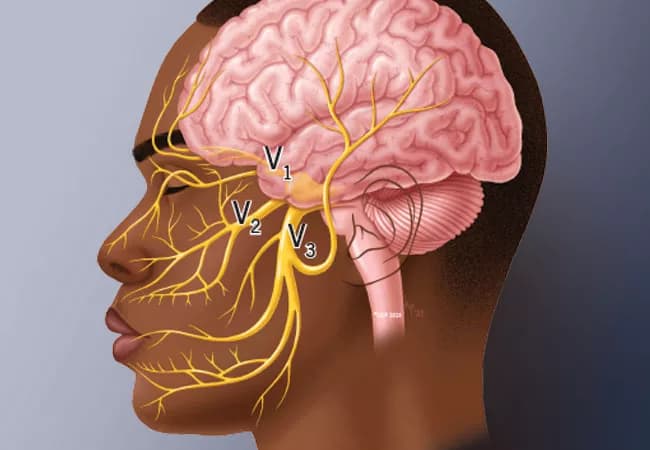
The trigeminal nerve (V) with its three branches: ophthalmic (V1), maxillary (V2), and mandibular (V3).

The lacrimal gland and drainage system. Stimulation of the trigeminal nerve triggers reflex secretion from the lacrimal gland.
Prior art
Clinical precedent.
TrueTear
2018Allergan · FDA De Novo DEN170086
Intranasal neurostimulator using small electrical currents applied to the nasal mucosa via inserted prongs. The first FDA-cleared device to use neurostimulation for tear production.
Clinical studies showed statistically significant increases in Schirmer tear test scores versus sham stimulation.
iTEAR100
2020Olympic Ophthalmics · FDA De Novo DEN190026
External vibrotactile neurostimulator applied to the lateral nose. Uses mechanical vibration rather than electrical current to activate the external nasal nerve.
Pivotal trial showed significant improvement in tear production versus sham. Demonstrated that external stimulation is effective and well-tolerated.
Differentiation
What's different about NeuroStim.
External electrical, not intranasal
No prongs inserted into the nose. The stimulation is applied to the external skin surface, making the device more comfortable and more practical for daily use at home.
Not vibratory, not mechanical
NeuroStim uses a precise electrical waveform rather than mechanical vibration. Electrical stimulation allows more granular control over stimulus parameters — frequency, pulse width, current density — enabling optimization of the reflex response.
Two-minute home-use protocol
A single session lasts two minutes with automatic timeout. Designed for daily use without clinical supervision — place the device, press the button, resume your day.
Be among the first.
Join the waitlist to know when NeuroStim ships.
We'll only email you about NeuroStim. Unsubscribe anytime.